






The Duress Alarm Interface
What Is It and Do I Want One?
The name itself makes you ponder – What exactly is that? The name sounds technical and fancy, but the fact of the matter is, there are definite pros and cons to this security feature. Before making the decision of whether to add a Duress Alarm Interface to your custom safe, let’s discuss what this device really is and how it works!
According to the Bureau of Justice Statistics, 27.6% of household robberies occur when a household member is present.
That little statistic is important because the Duress Alarm Interface is useful only if you fall victim to a home invasion. You personally must activate the alarm by punching a code into your lock’s keypad. Think of the Duress Alarm like a panic button. If you are not at home during the robbery, the panic button, or the Duress Alarm, will not provide any benefit, since there will be no one there to enter the code.
This feature works as follows; in the case of a home invasion, you enter a predetermined modified code on your safe lock’s keypad and the Duress Alarm Interface electronically sends a message from your safe to your home security company, thus the “interface”. You would enter this modified code if ordered by the intruder to open your safe, which in turn would both open the safe and send the alert, the later unbeknownst to the burglar. If you are not discovered by the intruder and have access the safe, you could enter this modified code on your own to get the panic message out. Now that you know how it works, let’s take a look at some of the pros, and also some of the hidden cons of the Duress.
Pros
- Ability to Notify Your Security Company – Having your security company at the touch of your fingertips (literally), is pretty enticing, especially in the case of a home invasion. That frightening moment, when a burglar enters your home, is when you need your security company the most. Having the Duress Alarm Interface, gives you that connection to your security company, as soon as you enter your code.
- Contacting the Police Discreetly – Because your security company is notified right away, they can contact the police. Obviously, the police will have a quicker response time with the help of this communication, than without it. In an ideal situation, the police would get to your home quickly and catch the intruder red-handed.
- Peace of Mind – Even though less than a third of home invasions occur when a household member is present, having the assurance of a panic button there just in case, can give peace of mind. It all comes down to weighing the pros and cons, which brings us to the cons…
Cons
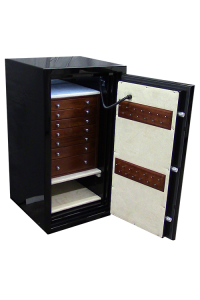
- Appearance – Notice the photo, the wiring coming out the inside of the door of the safe and traveling to the interior of the safe, is a key component of the Duress Alarm functionality. It’s not the most discreet feature, and depending on your safe’s configuration, it may be placed differently than you see it in this photo. Regardless of where it is, it will always be quite noticeable.
- Decreased Convenience & Usable Space – Closing the door of your safe may be complicated by the cabling, as it needs somewhere to go when the safe is closed. Your interior configuration must leave room, which will limit the number of drawers you can have in your safe. Choosing the Duress Alarm Interface will require some flexibility when it comes to configuring your safe’s design.
- Possible Hostage Situation – This last one sounds out of left field, right? But think about it, if the police were to arrive at your home in response to the alert and the robber is still in the home with you, what’s to stop him from grabbing you and turning an ordinary burglary into a hostage situation? Just something to think about before making your decision.
For more information about the Duress Alarm Interface or other extra security features for your jewelry safe, contact our Casoro safe experts.
