Introduction
Wildfires, burglaries, tornadoes, hurricanes and floods have had a major impact on our prestige clients, more than any other group. They build homes in gorgeous but vulnerable areas and are prime targets for theft. These clients have art, wine, jewelry, handbags, watches and a trove of high-value items that can be quickly destroyed by fire or easily liquidated for fast cash.
Designing for Risk is a new opportunity for improved relevancy of designer, builder and architect services. Imagine the delight and word of mouth advertising when your advice and guidance save a client from the loss of cherished items. Guiding the client through important decisions related to risk leads to the immediate and long term success of your brand. Risk management should be included with foresight and understanding, but today it’s often overlooked, for reasons we will discuss in the next section.
In our job we consider how people live, their behaviors, day to day needs and so many other aspects of their life, yet we forget about protecting what they are most passionate about and collect. We provide locked drawers for a client who has $250,000 in jewelry or watches as though that is security and fire protection. When burglars enter the home, they go right for the bedroom closets and then crowbar drawers open in seconds. The lock on the drawer screams ‘look here’. We create special shelves and displays for cherished possessions. We design wine rooms in earthquake zones with expensive bottles of wine on unsecured pegs to create a dazzling display through glass doors. We build multi-million-dollar dream homes to house priceless art collections with no idea about where to put smoke detectors or sprinkler systems in the most effective areas of the home. All of these are designs that don’t considering risk.
This guide was written to help us better understand Designing for Risk™ and provide practical approaches to reach this new level of service.
Intended Audience
The first edition of this guide is written with interior and closet designers, organizers, architects and custom home builders in mind. These are the people influencing high-net-worth and prestigious clients who are most at risk. This group has the trust of clients and/or their representatives. The intent was to collaborate with loss and risk experts to better understand client needs and then identify and share best practices that support designers, organizers, builders, architects and other professionals in servicing them.
Why Design for Risk™
According to our surveys, many still leave security, fire protection, burglary and other risk management design strategies to their clients. Yet we continue to hear about rework because risk mitigation needs were not discovered until the project was close to completion or done. There is a saying, do a hundred things right and one thing wrong, and the thing you did wrong is all they talk about. It’s true, people tend to talk about negative events more than positive ones, a phenomenon known as ‘negativity bias’. Research suggests that negative information and experiences tend to have a greater impact on our thoughts, feelings, and behaviors than positive ones. This bias is thought to be an evolutionary adaptation that helped humans survive by prioritizing potential threats.
The Chubb 2024 Wealth Report indicates that 81% of collectors worry most about theft, and 67% believe that damage to their collections during travel is their biggest risk. “High-value collections are a unique and irreplaceable part of many families’ legacies,” said Laura Doyle, Senior Vice President, Fine Art and Valuable Collections Product Leader, Chubb Personal Risk Services. “Protecting these assets requires specialized expertise and coverage, as they are more than just investments—they’re often deeply personal items that families want to preserve for future generations.” 1 It’s clear that this matters greatly to your client and something all designers, builders and architects should be considering.
The landscape of jewelry and watch theft is undergoing a stark transformation, with data from insurance giant Aviva revealing a 43% surge in claims related to high-end jewelry theft.2 In Southern California, home burglaries have increased in 2024, with a notable shift from commercial break-ins to more residential theft. While burglaries were down overall in the US, there was a sharp increase for high-net-worth homes signifying a different type of burglar gangs. Top cities around the globe, including London, Paris and Los Angeles, have seen a massive uptick in high-end watch robberies in the last year. The Los Angeles County Sheriff’s Department reported over 200 thefts involving at least one watch valued at $5,000 or more from January to mid-November 2022. This represented a nearly 30% increase compared to the same period in 2021.3 It’s not just the US, police data in the United Kingdom reveals a 41% surge in watch thefts in 2022. London accounted for nearly half of these crimes.4 At this point it should be noted that that the concern has been validated and the threat to your clients is real.
We must not forget losses from fires, particularly wildfires, in high-net-worth homes across the US, especially in California, have been substantial in recent years. In California alone, recent wildfires have caused significant fire losses for high-net-worth homeowners, with damage estimates exceeding $30 billion. We are seeing wildfires in places we never anticipated, putting our prestige customers at risk for losses.
Now, Imagine the reviews of your business or referenceable clients who’s most prized possessions were saved from a loss because of your foresight! This is a positive outcome for you, caused by a very negative event the customers will talk about for years. This is how to harness negative bias in a positive way for your brand. Designing for RiskTM is simply one more way to leverage potential negative outcomes into a positive experience and differentiate your services from others.
Why So Few Include Designing for Risk™ as a Service
In our research, we discovered some key reasons why so few successfully include risk as a core service in their project design and planning.
- Not aware that the issues exist – Maybe it lacks glamour, or something is missing from educational curriculums, but we found the majority of people we interviewed were not aware that Design for Risk™ was a tool they could use to elevate their services.
- Not aware of what their client owns or if it’s worth protecting – It was discovered that those interviewed knew about some but not all of their client’s prized possessions. Many stated that they had no idea how valuable the items were but did know that these items needed to be considered in the design. A designer or builder should ferret out these details, but sometimes clients have strong ideas regarding what they want and it’s easy to take a back seat and let them drive.
- Not knowing how to discuss the threat of burglary, wildfire, tornado, earthquake and other risks – While some recognize these threats, they struggled with discussing these negative threats with the client. However, many are not aware of the current threats that face their clients. It was found that the conversations came up more when there was a recent major wildfire loss or a high profile burglary. In most of these cases, the client brought the discussion to the forefront. Some indicated that as the news cycles move on, they tend to forget. For example, in 2024, the sophisticated theft rings were in the news because they were new. After a year or so, the burglaries are still going strong but only covered in the news when it’s a celebrity like Brad Pitt.
- No direct access to the client’s insurance broker, agent or carrier – This is all too common. Often the person responsible for insurance coverage is different than the person responsible for managing the redesign or new build project. Sometimes the client has not even considered insuring their collection until it’s time to move in. Many times, they have already purchased a safe without talking to their carrier, creating a difficult situation.
- Risk management, the placement of cherished items and the closet design are not high on the priority list of clients until later in the project – When building a dream home, most owners prioritize desired features like location, room layout, overall design, specific features like a pool, energy needs, colors, materials, a desire to reflect their personality and lifestyle and so on. We heard consistently that homeowners think about their kitchen, bathrooms and living spaces first. Often a closet design or where the art will be hung is deferred because there are so many other things to think about. However, we know the cost, potential delay or client irritation when additional wiring for security or smoke detectors, or sprinklers must be added, and the walls are already closed.
- Not aware if the client is planning on insuring or being self-insured for their collections – This is common but rarely asked. Often the broker and insurance risk professional are looking at the home after most of the work is done and unwelcome surprises result.
As you read more, you will be presented with real-life problems we discovered as we interviewed a variety of builders, designers and architects. Many of these stories resulted in major problems and very dissatisfied clients. Finally, we will provide helpful guidance on things to look for, questions to ask and tips on what to avoid.
Designing for Theft
Brad Pitt’s home in Los Angeles was recently burglarized while he was away on a promotional tour. Reports indicate that three suspects scaled the security fence, entered through a window, and ransacked the property, stealing an unknown amount of goods.
While it’s not confirmed whether Pitt had security guards explicitly stationed at his house during the time of the burglary, it is widely known that celebrities frequently employ private security for their residences and personal protection. This is due to the unique security challenges they face, including dealing with paparazzi, stalkers, and potential criminal activity.
Celebrity home security often involves a comprehensive approach that can include:
- Surveillance Systems: Monitoring the property with cameras.
- Gated Properties: Restricted access points to the property.
- Trained Security Personnel: Employing individuals with security expertise, potentially including former law enforcement or military personnel. *(this came from multiple news sources)
This story is all too common. For example, in the past year all of these high-profile athletes who live in gated communities, that have security guards, were robbed while they were playing a televised game.
- Luka Dončić – Dallas Mavericks
- Patrick Mahomes – Kansas City Chiefs
- Travis Kelce – Kansas City Chiefs
- Joe Burrow – Cincinnati Bengals
- Bobby Portis – Milwaukee Bucks
- Mike Conley – Minnesota Timberwolves
Myth: I live in a gated community with security guards, so I am safe from burglary.
Sadly, this is one of the most widespread and widely held myths in our industry. What we have learned is that living in a gated community indicates to thieves, there are valuables there. You may see a security guard at your client’s gate, and possibly one driving around in a golf cart. What you are not seeing is the plethora of weak security issues and opportunities that jump out to professional thieves. Don’t be hard on yourself or your client for not seeing these, your mind is trained to earn a living the legal way.
“I have consulted on numerous cases where homes within in gated communities with security surveillance were struck by sophisticated thieves, often driving marked trucks or vans for known service representatives within the neighborhood with license plates obscured. Upon confirmation of an empty home, a ladder is brought to the rear of the property, the home is entered via an upstairs window, and a secured or unbolted safe is simply heaved out said window and placed within the service truck – with no one the wiser until the homeowner returns.” Said Angelique Brelsford, GIA GG, of J.S. Held.
We want to believe we are safe so we sleep better, but that does not change the facts. Thieves know that most security systems are on the ground floor, windows are left open when people go out for the evening because of this false sense of security. The fences that keep you safe are easy to scale, the perimeter of the complex is surrounded by accessible land, your gated community is full of workers servicing clientele in the neighborhood, coming and going all day long. Even the security personnel have patterns that are being learned by thieves. We had a builder tell us about how thieves stole their ladder while building a new home and used it to gain access to the 2nd story of the homes on either side of the home under construction! We could dedicate a substantial portion of this guide to explaining all the vulnerabilities thieves see, but we feel it is more useful to focus on this simple fact: They will and can get into any gated community, so focus on how to help your client protect themselves and the things they are passionate about.
Considerations
Without belaboring this false sense of security, it should be clear to the reader that security is something we need to address in our designs, construction, and inside the home. We will discuss similar topics regarding fire and other potential threats in subsequent papers. Considering a multi-layered security approach is the most recommended approach by risk managers withing the insurance industry. Don’t be afraid to educate your client on the need and explain the challenge they face. Be honest that you are looking out for their best interests. Most will appreciate this and you’ll have the peace of mind knowing you tried your best. While understanding what thieves think about and consider is a much bigger task than our goal in helping to Design for RiskTM, here are some core things to consider:
- Thieves want to move quickly, get in, grab what they can, get out and escape the property – Don’t make it easier for them!
- The primary bedroom, closet and bathroom are the first stop and often the last stop if the haul is good – Don’t make your design like an all you can eat buffet for thieves.
- The second story is the chosen entry point because it often has the weakest security – this may or may not be something you can address other than accounting for this in the design.
- Many jobs are what we call “inside jobs” where they have acquired the targeted items, location and homeowner behaviors – painters, cleaners, repair workers, installers, window cleaners, and many others gain access to peoples homes all day long and we know very little about them.
- They do not fear gated communities with security guards – it appears they prefer these communities, maybe because it creates a false sense of security or because they know the risk is worth it.
- Thieves can be quite clever and spend their time looking for vulnerabilities we don’t see – One of the most difficult things to do is put ourselves in the desperate mind of thieves. This is their chosen profession, for whatever reason, and they know as much about this as you know about your profession. We underestimate them greatly. The internet has information on any topic and connects any possible community together to exchange information, and this includes thieves.
Myth: I only need to lock valuables up when I am traveling. I only need my security system turned on when I go away for extended periods.
While it is recommended by risk experts to have even more security, including UL TL30 rated safes, a lot of robberies are happening when you are out for only a few hours. Thieves look for patterns like going to dinner every Saturday night for two hours, your regular weekly long-walk or other consistent behaviors. Remember, they are counting on being in and out within fifteen minutes. Hidden wireless cameras are being found all over Southern California remotely monitoring homes by thieves. These incidents often involve cameras camouflaged in shrubbery or disguised as everyday objects and are often linked to organized burglary schemes. This is only one of many clever tactics used by today’s home burglars.
Client Collectables
Our clients surround themselves with treasures – handbags, watches, shoes, jewelry, stamps, and rare firearms – each a reflection of their passions and legacy. Some may dismiss theft, knowing that their collection is insured. Others see their pieces as irreplaceable – collectors’ items or steeped in sentiment. “High value jewelry and collectibles can be more than a financial investment. These precious objects can be symbols for moments in time and memories of loved ones. ” said Angelique Brelsford, GIA GG, of J.S. Held.
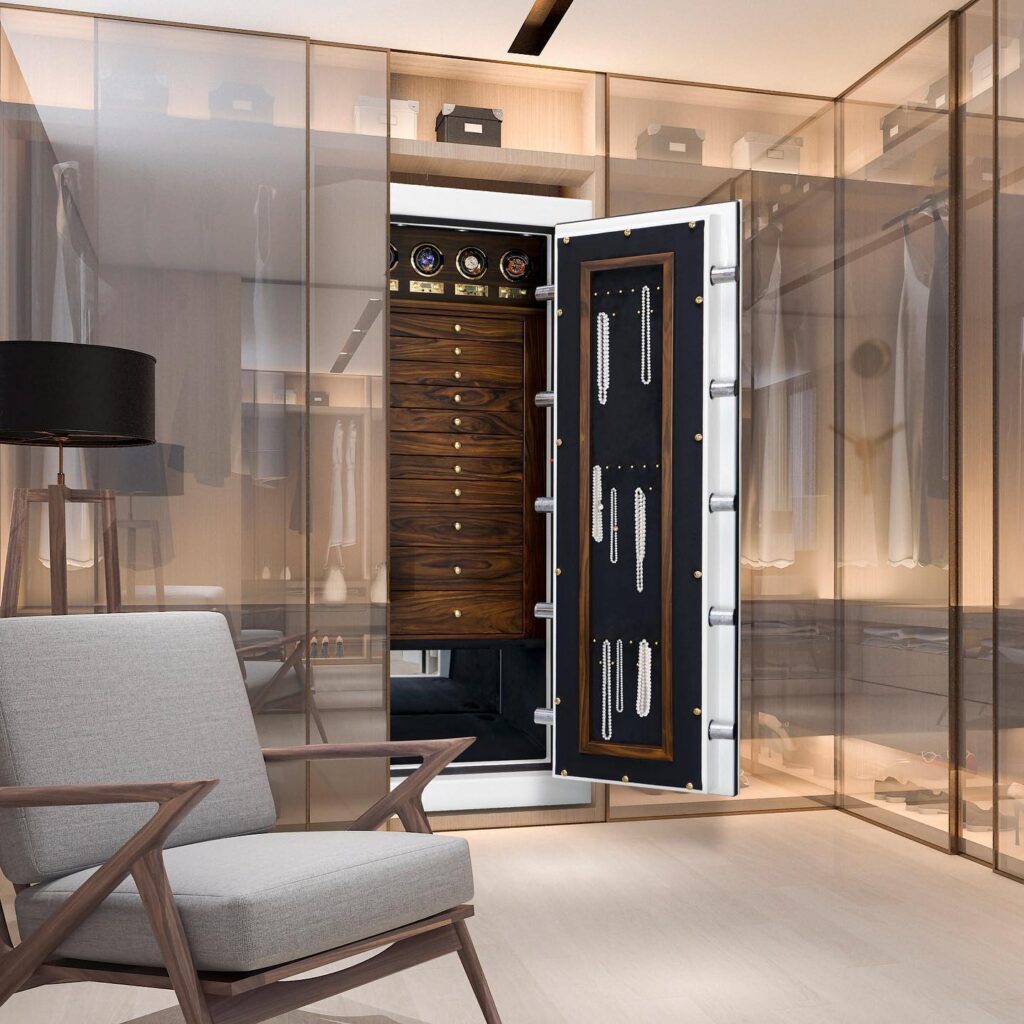
It’s ideal to understand what category these items fall into, then separate them into groups A and B. Group A being more precious to the client and B being more expendable. In doing this, you can design around these two groups separately. For example, for your B collection of watches you might feel comfortable displaying in wall mounted watch winders for a dazzling effect on the design. With the A collection, you may put these on watch winders in a high-security safe. This is just one example of a multi-layered protection design.
Multi-layered Security Protection
A multi-layered approach for burglary consists of different security measures that interact with each other to deter and slow a thief’s progress. Some security may already be in place but considering gaps or weakness is important for your client. Remember, they are not thinking like a thief and may likely be feeling a false sense of security. This false sense of security may be a challenge for your efforts but do not let that deter you from doing what is best for your client. Let’s consider the broad categories of security for a high-net-worth home:
- Perimeter security or deterrents – These are cameras, walls and gates that may have spikes or other deterrents on top, security guards, gated or monitored access and other sensors around the exterior. As discussed, these are not foolproof and often have gaps that may not be obvious to anyone but a professional thief. Thieves have often been observing the home for a while before the burglary via access as a landscaper, other service people or cameras hidden on a neighbor’s property pointed at your client’s home. When they attack thieves wear masks, avoid cameras and find gaps in the physical security staff.
- Premise security – These include door, window, glass breakage, motion and camera sensors. These systems are great but can be avoided if there are limited sensors on the second floor, which is common. Also, premise sensors may be jammed by more sophisticated thieves which is why hardwired sensors are best. If the alarm is triggered and alerts the police, there is still time to get in and out with jewelry or other items if the thief knows what they want, where it is located and if the items are easily accessed. Today’s thieves have already tested police response time and know how much time they have to get in, grab a few key items, get out and climb over the wall.
- Safes, vault rooms and hidden access areas – This is the last line of defense, designed to cost the thieves lots of time. Ideally, enough time that they give up. For example, we have a UL rated TL-15 safe that was worked on for 46 minutes, on camera, before the thieves gave up. We also have a UL RSC rated safe that lasted 18 minutes before the thieves gave up. Protection is about chewing up time.
The primary bedroom is the first stop for thieves, don’t make it an all you can eat buffet. If your client wants to see some items displayed and are not comfortable putting all they own in a safe, there are solutions. In the previous section we described the A and B collection concept. In that example we had the B collection watches providing a dazzling display while also functioning as a decoy or “easy Pickens” for a time-pressured thief.
The next stop in the layered approach is disguise. Many recommend a safe be behind a door or secrete panel, unless it is a decoy safe. You can have fun with this to create an exciting design. We have clients implementing the A/B collection approach and then a hidden panel that opens up to their treasure room, with a security door and a safe, that contains their A collection. This adds a level of excitement to the design but incorporating a dazzling approach and a “James Bond” experience around the most prized possessions.
However, even a hidden panel can be discovered which is why you should still recommend a safe. In the scheme of things, the cost is minimal, and it adds a level of deterrent that you will be thankful for. I hear many say, this panel is so hidden, no one will know. That may be a false sense of security for several reasons and remember, many robberies have an “inside” element. Cleaners, repairers or service people may discover what you think is undiscoverable. Cleaners and thieves notice the most subtle things you can’t imagine. An odd wearing on a wall panel that they keep trying to polish to no avail, marks on floors or rugs over time, a button they just curiously press, and other things. The real goal of hiding a safe is to make it less of a target. The real purpose of a safe is that if the space is discovered you will stop or slow the thief down substantially. How safes slow thieves down will be discussed in detail in the next sections. Remember, many thieves have inside information.
Getting more technical in our multi-level approach is the concept of hardwiring your safe into to your security system and bolting it down. Both of these require a bit more forethought and awareness early in the project to consider infrastructure needs. Wiring and power may need to be brought to the location of the safe. The floor may require some reinforcements to bolt into for maximum effect. These are highly effective but require knowing early in the project.
Understanding Safe Security Ratings and Logistics
There is only one major burglary rating and testing organization for safes in the US, UL Solutions (previously known as Underwriters Laboratories) founded in 1894 to provide testing for electronics safety. They grew to be the most trusted 3rd party for validation of underwriting risk. Their label carries a lot of weight with insurance companies. There are two agencies for fire ratings that will be discussed in a future Designing for Risk installment focused on fire protection.
Why trust UL Solutions and not the word of the safe manufacturer? Unfortunately, carrying the certification is costly. Standards and regular inspections add cost to the safe. Plus, each safe rating must be certified which means if you carry UL RSC1, RSC2, TL15, Tl30, T30x6, TRTL30 and TRTL30x6 you must fund and maintain 7 certifications! That adds cost to safe products. Not having safes validated by UL Solutions saves money and allows for cost cutting in the manufacturing approach not otherwise allowed by UL Solutions. You must carry certifications for each individual rating but some manufacturers will carry just a UL TL-15 or just UL RSC Level 1 so that they can hang the UL shingle on their website. Ensure you know if the specific safe you are buying holds its own UL rating.
As a designer, builder, organizer or architect, UL certification removes risk and liability, so we highly recommend you always request proof. Since we have found that many engage in misleading tactics, the best way to double check is to look them up in the UL database or request a certificate from the safe manufacturer. Also, safes manufactured in the US typically matter. There is one non-US safe manufacturer that we know of that carries UL ratings and that company is located in South America. European Union safes, if rated, carry a different rating system that is not compatible with US insurance carriers but may be accepted. We recommend you validate the safe with the insurance carrier early on.
Read this blog to learn more about UL Burglary Ratings.
Contributors


Cletus Nunes, President, Casoro Jewelry Safes ~~~~~~~ Angelique Brelsford, GIA GG, of J.S. Held